Some paintings feel sunny the moment you look at them, before you even notice the sky. Usually that isn't because the colors are brighter. It's temperature: the parts touched by sunlight lean warm, the parts in shadow lean cool, and our eyes read that contrast as light.
For a long time I painted every shadow with a gray, usually a bit of Payne's grey thinned down. My pages looked tidy but never sunny. The day I switched to a cool blue-violet for the shadows and a faint warm tint on the sunlit walls, the same cottages suddenly looked like they were standing in an afternoon.

New to painting coloring pages? Start with my step-by-step guide on how to watercolor a coloring page, then come back to this one.
What warm and cool mean
Reds, oranges and yellows feel warm, like sunlight or a fire. Blues, blue-greens and violets feel cool, like water, sky or shade. Every color also comes in warmer and cooler versions of itself: a golden yellow is warmer than a lemon yellow, ultramarine is warmer than cerulean.
Why shadows look blue
On a sunny day the light from the sun is warm, so everything it touches picks up a little gold. Shadows aren't lit by the sun at all. They're lit by the blue sky, so they pick up a little blue. That's why snow shadows look blue and a white wall in shade often looks lilac.
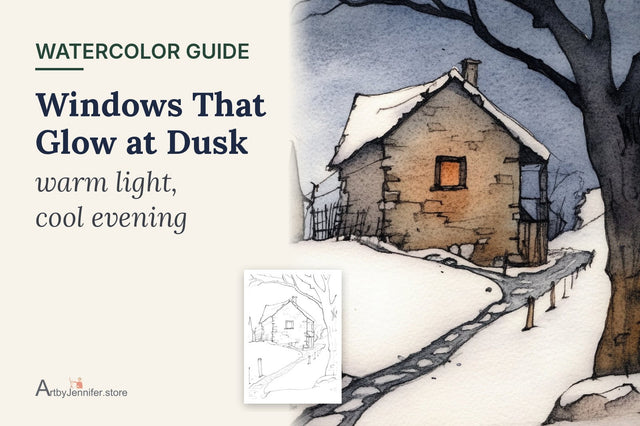
This is the idea behind almost every sunny page I paint, and it comes up again in my posts on snow, cottage shadows and glowing windows at dusk. This is where it's explained in full.

Warm the light, cool the shadows
If a white wall faces the sun, don't leave it pure white; give it a whisper of yellow ochre. If the other wall is in shade, don't paint it gray; paint it a soft blue-violet. The difference in temperature between the two walls does more to suggest sunlight than any amount of bright color.
It helps to mix two versions of each important color before you start:
| Object | In sunlight | In shadow |
|---|---|---|
| White wall | Very pale yellow ochre, or bare paper | Pale ultramarine with a touch of rose |
| Red roof | Cadmium red with a little orange | Cadmium red with a little ultramarine or crimson |
| Green grass | Sap green with yellow | Sap green with ultramarine |
| Stone path | Yellow ochre | Yellow ochre with a soft violet glaze |
| Gray rocks | Warm gray (more burnt sienna) | Cool gray (more ultramarine) |
The shadow version isn't just darker; it's cooler. A shadow made by adding black or gray looks dull. A shadow made by adding blue or violet looks like daylight. For mixing those cooler grays, see Natural Grays in Watercolor.
Decide where the sun is
Before you paint, choose a direction for the light and stick to it. On this page the sun comes from the left. So the left-facing gable, the left side of the chimneys and the tops of the rocks are warm and light, while the front wall, the undersides of the eaves and the right side of each rock are in cool shadow. Shadows on the ground fall away to the right.
A tiny pencil arrow in the margin is a good reminder while you work. Without one, I've caught myself halfway through a page putting a shadow on the sunny side out of habit.
How I painted the cottage on the rocks

- Sky. A soft cerulean wash, slightly stronger at the top, with a few white clouds left. Cerulean is a cool, clean blue that makes the warm colors below look warmer still.
- Sunlit areas. A pale wash of yellow ochre on the sunny side of the cottage, the path and the field, kept very light: I was tinting the light, not painting the walls a color. The roof is cadmium red, a little more orange on the sunlit slope.
- Shadow side. Once that was dry, a cool blue-violet from cerulean and ultramarine with a touch of rose went over the shaded wall in one smooth pass. The same mix with more red went on the shaded part of the roof and under the eaves.
- Rocks and grass. The color guide uses Payne's grey for the rocks. I painted the sunlit tops warmer, with a little burnt sienna dropped in, and the shaded faces cooler, with more blue. The grass is sap green warmed with yellow ochre in the light and cooled with blue in the shade.
- Cast shadows and details. Last, the cast shadows on the ground and across the path in a transparent cool violet, wet-on-dry, then the blue door, the windows and a few dark accents.

Small things that make light glow
- Keep the light areas simple. Too much detail in sunlit areas makes them busy; let the light flatten them a little.
- Put the detail in the shadows. Windows, doors and textures read best in the cooler, darker areas.
- Let color bounce. A touch of warm orange in a shadow next to a sunny path looks like reflected light.
- Save some white paper. Small untouched spots are the brightest light you have.
Common light and shadow problems
| What you see | Why it happens | What to try |
|---|---|---|
| Painting looks flat | Same temperature everywhere | Warm the light side, cool the shadow side |
| Shadows look dirty | Black or gray added | Darken with blue or violet instead |
| Light seems to come from everywhere | No light direction chosen | Pick one side for the sun and keep to it |
| Sunlit wall looks yellow | Warm wash too strong | Use a very pale tint, or leave bare paper |
| Shadow hides the details | Shadow mix too thick | Glaze a thin, transparent cool wash |
Frequently asked questions
Why are shadows blue in watercolor paintings?
On a sunny day, shadows are lit by the blue sky rather than the warm sun, so they take on a cool blue or violet tint. Painting them that way makes the scene look sunlit.
What color should I use for shadows?
A transparent cool mix such as ultramarine with a little rose or burnt sienna works on most surfaces. Glaze it over the dry local color.
Does this work on a cloudy day?
Yes, more gently. On an overcast day the light is soft and cooler, so the difference between light and shadow is smaller. Use softer contrast and fewer warm tints.
Practice pages
Cottages on hillsides and coastal paths are lovely for practicing sunlight. The 42 Memories House set has many of them, each with a color guide showing the paints I used.
The shadow side of this lesson, form shadows versus cast shadows, has its own post: Shadows That Make a Cottage Glow.