Old stone walls, worn brick and weathered wooden doors give a cottage its character. They're also the parts of a coloring page that make a lot of people nervous, because all those stones and planks look like a lot of work.
I used to outline every stone in a darker brown, one by one, because the line art showed them all and I thought that was the job. After an hour the wall looked like a neat brown grid, more like graph paper than old stone. Texture in watercolor turned out to be mostly about what you leave out.

New to painting coloring pages? Start with my step-by-step guide on how to watercolor a coloring page, then come back to this one.
Color first, texture last
Whatever the material, I start the same way: the overall color of the whole wall or door in one simple wash. Only when that's dry do I add texture, and only in a few places. Your eye fills in the rest. A wall with texture in three or four spots looks more convincing than one where every stone has been painted separately.

Stone
- Wash the whole wall with a pale yellow ochre.
- While it's still damp, drop in a little raw sienna or burnt sienna here and there, especially near corners and the ground. The colors blend softly, just like weathered stone.
- When it's dry, paint a few individual stones a shade darker, leaving thin pale gaps between them. Those gaps read as mortar, so there's no need to draw mortar lines.
- Make a few stones lean cool, a pale blue-gray, among the warm ones. A mix of warm and cool stones is what makes a wall look old.
- Add a soft cool shadow under the eaves and beside the door.
For mixing those warm and cool stone colors, see Natural Grays in Watercolor.
Brick
Brick is more regular than stone, which makes it very tempting to paint every one. It's tempting, but you don't need to:
- Wash the wall with a pale mortar color, a light gray or warm cream.
- When dry, paint a handful of bricks with burnt sienna and a touch of red, in small groups scattered across the wall.
- Vary the color from brick to brick, some warmer, some paler. Pure red looks too new; burnt sienna with a little red looks lived in.
- Leave large areas suggested only by the base wash.
Ten well-placed bricks say "brick wall" better than two hundred careful ones.
Old wood
Weathered doors, shutters and fences are some of my favorite things to paint, because they're so forgiving:
- Paint the door with burnt sienna, slightly darker at the bottom where it's most weathered.
- When it's almost dry, drag a fairly dry brush down the length of each plank for streaks of grain. Dry Brush Watercolor: Texture for Wood, Grass and Stone shows how to load the brush.
- When it's fully dry, add thin dark lines between the planks and a little shadow under the iron hinges.
Follow the direction of the grain: vertical planks get vertical strokes, a horizontal beam gets horizontal ones.
For painted doors, glass panes and a glazed mahogany door, see How to Paint a Door in Watercolor.
How I painted the stone cottage with a rose arch

The stone walls. Following the color guide, I washed the stone with yellow ochre, then deepened it with raw sienna and a little burnt sienna at the corners and near the ground while it was damp. The roses and leaves stayed unpainted for now.
The door and roof. Burnt sienna for the wooden door and the roof edge, with dry brush grain on the door and thin dark lines between the planks once it was dry.
Stones and shadows. With the wall dry, I picked out a few stones in a slightly darker mix, a few in a cool blue-gray, and left pale gaps around them. A soft blue-gray shadow went inside the doorway arch and under the eaves, darkest where the door sits back into the stone.
The rose arch. The roses are dabs of quinacridone rose and the leaves sap green. The color guide has a nice tip here: let a few roses touch the stone while it's damp, so they blend a little and look like they're really growing there.
Pots and flowers. Last, cadmium orange pots and lemon yellow flowers at the foot of the steps. Those bright touches make the old stone look warmer still.

Where to put texture
Texture shows best on the sunlit side of a wall, so that's where I put most of it, and I let the shadow side stay simpler. Climbing roses and ivy are your friends too: they cover large areas of wall, which means less stone to paint and a softer, more natural cottage.
Common texture problems
| What you see | Why it happens | What to try |
|---|---|---|
| Wall looks like a grid | Every stone or brick outlined | Leave pale gaps; paint only a few stones |
| Wall looks flat | One color all over | Drop in a second warm color while damp |
| Wood looks like plastic | Smooth, even wash | Add dry brush grain and dark plank lines |
| Texture looks busy | Detail everywhere | Keep texture to the sunlit areas |
| Bricks look too bright | Pure red | Mix burnt sienna with a touch of red and vary it |
Frequently asked questions
How do you paint stone walls in watercolor?
Wash the wall with yellow ochre, drop in raw sienna while damp, then paint a few darker stones with thin pale gaps between them.
Do I need to paint every brick?
No. Paint a pale mortar wash, then a few small groups of bricks. Your eye fills in the rest.
How do I make wood look old?
Use burnt sienna, add dry brush streaks along the grain, and finish with dark lines between the planks and a little shadow under the hinges.
Practice pages
The 21 Vintage Doors & Windows set is full of stone walls, old wooden doors and climbing flowers, each with a color guide.
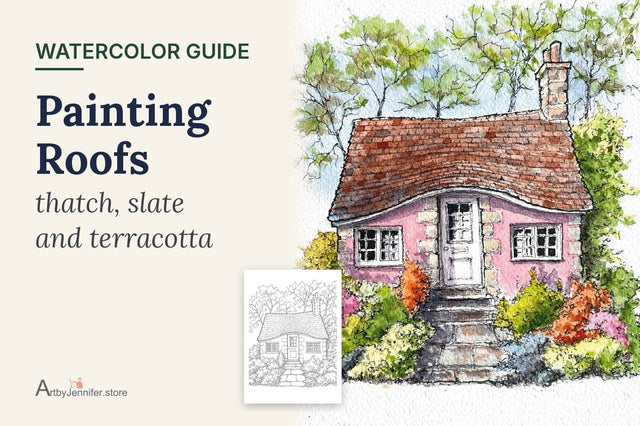
Roofs are the other half of a cottage's texture, and Painting Roofs: Thatch, Slate and Terracotta covers them.