A reflection on calm water sits straight below the thing it reflects, a little darker or softer, and simpler. That's most of what you need to know. The rest is getting watercolor to blur in the right places, which it's happy to do, because watercolor is wet and fluid just like water.
My first reflections looked like a second, upside-down lighthouse: every window, every railing, crisp edges, same bright white. It read as two towers stacked end to end rather than one tower over water. What fixed it was painting the reflection into wet paint and letting most of the detail go.

New to painting coloring pages? Start with my step-by-step guide on how to watercolor a coloring page, then come back to this one.
Five rules for reflections

- Reflections go straight down. However the light falls, a reflection on calm water sits directly below the object, not off to the side.
- Light things reflect a little darker. A white lighthouse reflects as a pale blue-gray, not pure white.
- Dark things reflect a little lighter. Dark rocks and trees reflect slightly softer and paler than they are.
- Reflections are simpler. Small details like windows and railings mostly disappear in the water.
- Movement breaks them up. The choppier the water, the more the reflection breaks into horizontal ripples.
Water absorbs and scatters a little light, which is why a reflection is never a perfect copy.
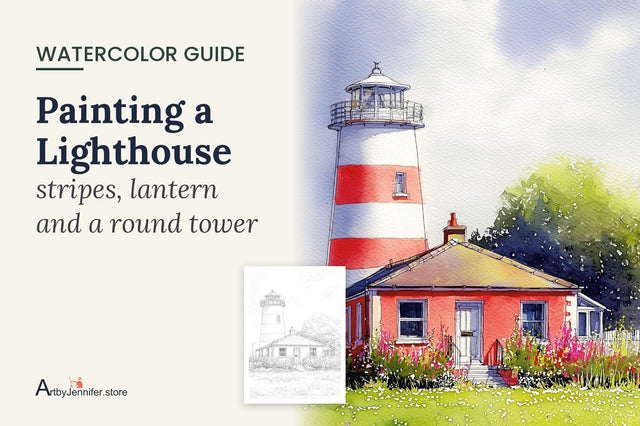
How I painted the white tower above the bay

Sky and sea
A soft, pale sky with a little cerulean and some white left for clouds, kept light so the lighthouse stands out. Then the sea in bands, as the color guide suggests: turquoise near the shore and ultramarine further out, with the horizon dead level. A tilted sea line throws the whole page off, so I mark mine with a ruler first.
The headland
The grassy headland is sap green and yellow ochre, and the rocks Payne's grey with a little blue, darker toward the water. The lighthouse and cottage walls stay white, with a soft blue-gray shadow on the shaded side, all painted wet-on-dry so the edges stay crisp.
The water and reflection, wet-on-wet
- I wet the whole water area below the headland with clean water.
- Turquoise and ultramarine went in, stronger toward the bottom of the page.
- While it was all still wet, I pulled downward strokes of pale blue-gray directly under the lighthouse for its reflection, and darker blue-green under the rocks. They blur on their own, which is exactly what you want.
- Then I left it alone to dry completely. Reflections look freshest when you stop as soon as they've blurred.
If wet-on-wet is new to you, Wet-on-Wet or Wet-on-Dry covers how wet the paper should be.
Ripples and sparkle
Once the water was dry, a few thin horizontal ripple lines in a slightly darker blue went across the reflection. The tip on this page's color guide is one of my favorites: leave a few thin horizontal streaks of white paper in the water. They read instantly as light glinting on the surface. You can paint around them or lift them out afterwards, as in Lifting and Softening Watercolor. The bottom edge of the water wash I left loose and ragged on purpose, so the page fades out instead of stopping in a box.

Calm water or moving water?
The calmer the water, the clearer the reflection. On a still lake or a sheltered bay early in the morning, reflections can be long and almost mirror-like. On a breezy day, the surface breaks the reflection into short horizontal dashes, and it may barely reach a third of the way down.
Decide which kind of day you're painting before you start. For calm water, keep the strokes long and vertical and let them soften wet-on-wet. For moving water, paint the reflection as a column of short horizontal strokes with small gaps of white between them. Either way, it stays directly below the object.
Common reflection problems
| What you see | Why it happens | What to try |
|---|---|---|
| Reflection looks like a second object | Too sharp, too detailed, too bright | Paint it wet-on-wet, slightly darker, and drop the small details |
| Reflection slants sideways | Painted at an angle | Pull strokes straight down below the object |
| Water looks flat | No ripples or sparkle | Add horizontal ripples and white streaks when dry |
| Hard blotches in the water | Reflection added to half-dry paint | Work while the water area is evenly wet |
| Sea seems to tilt | Horizon not level | Mark the horizon with a ruler first |
Frequently asked questions
How do you paint reflections in watercolor?
Wet the water area, drop in the water color, then pull the reflection colors straight down below each object while it's wet. Add ripples and sparkle when dry.
Are reflections lighter or darker than the object?
Light objects usually reflect a little darker and dark objects a little lighter, so reflections have less contrast than the real thing.
How do I make water sparkle?
Leave or lift thin horizontal streaks of white paper across the water. They read as light glinting on the surface.
Practice pages
The 29 Simple Lighthouses set has plenty of lighthouses standing over calm water, each with a color guide to help you plan the reflections. If you'd like to paint the sea itself first, start with How to Paint Watercolor Skies and Sea.