Halloween paintings don't have to be scary. My favorite kind is the cozy sort: a crooked old house under a crescent moon, glowing windows, a black cat on the roof and a row of pumpkins by the steps. Somewhere you'd happily knock on the door.
Night scenes in watercolor have two classic traps: darks that turn flat and lifeless, and pumpkins that look like orange circles instead of round fruit. Here's the palette I use, how I mix a black that still has life in it, and how I painted the Black Cat House.

New to painting coloring pages? Start with my step-by-step guide on how to watercolor a coloring page, then come back to this one.
A cozy Halloween palette
Six paints cover most of my Halloween houses: three cool and dark for the night, three warm and bright for the light.

- Indigo: a deep blue-black for the house walls and the night sky.
- Ultramarine: the blue half of my mixed black, and lovely for moonlit shadows.
- Burnt umber: the brown half of my mixed black, and great for old wood, fences and bare trees.
- Lemon yellow: the brightest heart of every window and the moon's glow.
- Cadmium orange: the warm edge of the window light, and the pumpkins.
- Cadmium red: fall leaves and a little warmth in the pumpkins' shadows.
A black that still feels alive
My first Halloween houses were painted with black straight from the tube, and they looked like holes cut in the paper. A black mixed from ultramarine and burnt umber is just as dark, but it has color in it, and you can tip it either way: bluer for night air and roof slates, browner for wood, tree trunks and black cats.
Mix plenty, with less water than usual, so it goes on dark in a single layer. Going back over a dark area several times lifts and muddies what's underneath. Why two opposite colors make such good darks is explained in Natural Grays in Watercolor.
The windows, briefly
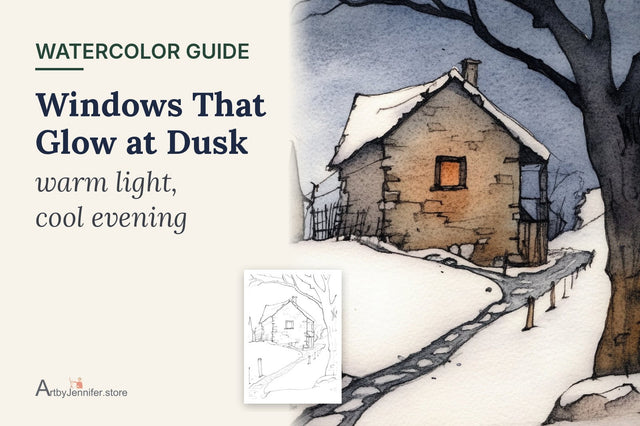
Paint the windows first: lemon yellow in the middle, cadmium orange dropped into the edges while damp, then let them dry completely before any dark goes near them. The dark wall painted right up to that dry yellow is what makes it glow. I go through it step by step in Windows That Glow at Dusk.
Pumpkins that look round
A pumpkin painted in one flat orange looks like a sticker. To make it round, treat it like a ball with grooves:
- Paint the whole pumpkin in cadmium orange, leaving a small spot of paper or very pale yellow where the light hits the top.
- While it's damp, drop a little cadmium red into the side away from the light so the orange deepens as it curves away.
- Once it's dry, run a slightly deeper orange down each groove with the tip of the brush, following the curve. The grooves are what tell the eye it's round.
- Finish with a little dark under the pumpkin where it sits on the ground, and a burnt umber stem.
If your pumpkins are carved, paint the faces as tiny glowing windows: yellow and orange first, dark pumpkin skin around them after.
Cats and the moonlit sky
Black cats: use the ultramarine and burnt umber black, slightly bluer on the side facing the moon. Paint the eyes yellow first and the dark around them later, or leave tiny white dots. A cat with bright eyes looks friendly rather than spooky.
The moon: leave it as paper, or give it the faintest wash of lemon yellow. Around it, the sky is a soft blue-gray that darkens toward the top corners. Loose vertical strokes give it a lovely streaky, old-storybook feel.
How I painted the Black Cat House

- Windows first, as the color guide suggests: lemon yellow with cadmium orange dropped into the edges, including the round window at the top and the little one in the turret. Then everything dried.
- The house: walls and roof in indigo with a little burnt umber, one section at a time, painted carefully around the windows. I let a little more water into the paint on the side facing the moon so that side stays slightly lighter and the house keeps its shape.
- Sky and moon: streaky blue-gray around the crescent moon, darker at the top corners.
- The cats went in last of the darks, so they'd be the deepest values on the page.
- Pumpkins and leaves: cadmium orange pumpkins with red on the shadow side, a few cadmium red leaves in the trees, and a little splatter for falling leaves.

Common night painting problems
| What you see | Why it happens | What to try |
|---|---|---|
| Dark areas look flat | Tube black or overworked layers | Mix ultramarine and burnt umber; paint it in one layer |
| Windows look dull or green | Yellow added after the dark | Paint the windows first and let them dry |
| House looks like a black cut-out | No variation in the dark | Leave the moonlit side a little lighter |
| Pumpkins look flat | One even orange all over | Deepen the shadow side and paint the grooves |
| Doesn't feel like night | Warm or pale sky | Use a cool blue or blue-gray sky |
Frequently asked questions
How do I mix black in watercolor?
Mix ultramarine with burnt umber, using plenty of pigment and not much water. Lean it bluer or browner depending on what you're painting.
How do I paint a pumpkin in watercolor?
Paint it orange with a small light spot on top, drop red into the shadow side while it's damp, then paint the grooves with a deeper orange once it's dry.
Can I use these colors for other night scenes?
Yes. The same palette works for Christmas cottages, lantern-lit streets and lighthouses at dusk.
Practice pages
The 35 Halloween Cottage set is full of glowing windows, black cats and pumpkins, and every page comes with its own color guide.