Weathered barn boards, rough stone walls, a tangle of dry grass: they all have broken, scratchy texture where bits of white paper still sparkle through. You get that with a brush that's almost out of paint. It's called dry brush, and it's one of the simplest ways to make a coloring page look hand-painted.
Where a wash flows, dry brush skips. You drag a lightly loaded brush across dry paper so the paint only catches the tops of the paper's texture. Below is how to load and hold the brush, three textures to try, and how I used it on the old red barn in this post.

New to painting coloring pages? Start with my step-by-step guide on how to watercolor a coloring page, then come back to this one.
How dry brush works
Watercolor paper isn't flat. Under a magnifying glass it looks like a landscape of tiny hills and valleys. A wet, loaded brush fills the valleys and gives you a smooth wash. A brush with very little water only touches the hilltops and leaves the valleys white. Your eye reads those tiny gaps as texture: grain in wood, glints on stone, light between blades of grass.
So two things matter most: how much water is in the brush and how dry the paper is.

Loading the brush
- Pick up paint at milk to honey strength, a little thicker than for a wash. Thin, watery paint just makes pale smudges.
- Touch the brush to a tissue or kitchen paper to draw out most of the water. You want the hairs damp with color, not dripping.
- Try a stroke on a scrap of the same paper. If it gives a smooth, solid line, blot again. If it skips and breaks up, you're ready.
For wider texture, press the brush gently onto the tissue so the hairs splay out. A splayed round brush or an old flat brush makes several fine lines at once, which is perfect for grass and wood grain.
Holding the brush
Hold the brush lower than usual, so the side of the hairs touches the paper rather than just the tip. Use light pressure and a quick, confident movement. Slow, heavy strokes push the paint down into the valleys and the texture disappears.
The paper has to be completely dry. I've ruined more wood grain by being impatient than any other way: the base wash looked dry, I went in with the dry brush, and every stroke melted into a soft smear because the paper underneath was still damp. If it feels even slightly cool to the touch, wait.
Three textures to try
Wood
Drag the brush in long, slightly wavering strokes along the boards. Let some strokes stop and start, and vary the pressure so a few lines come out darker. Leave thin gaps of the base color showing. For old, weathered wood, try a grayish brown such as burnt sienna with a little blue.
Grass
Start at the base and flick upward in quick, slightly curved strokes, lifting off the paper as you go so each blade tapers. Overlap a few colors, an ochre, a green and a touch of burnt sienna, for a natural mix of living and dry grass. A few well-placed flicks look better than a solid block.
Stone
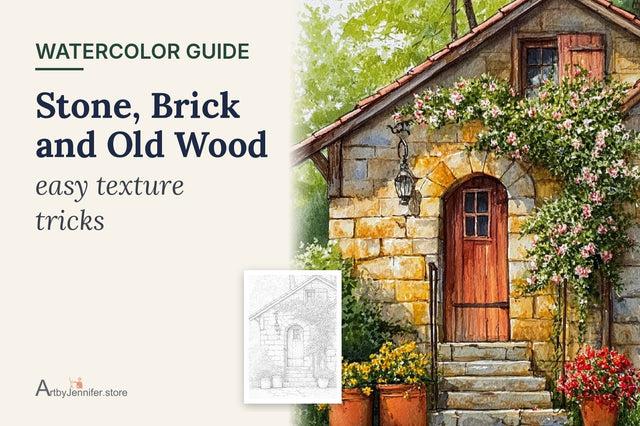
Paint the stones a pale base color first and let it dry. Then dab and drag the brush in short bursts across each stone, changing direction a little. A darker dry brush mark along the bottom edge of some stones makes them feel solid. There's more on this in Stone, Brick and Old Wood.
Which brush and paper work best?
| Choice | Why it helps |
|---|---|
| Cold press or rough paper | More surface texture, so more broken marks |
| Hot press (smooth) paper | Finer, subtler texture; harder to get sparkle |
| Round brush, size 6 to 8 | Versatile; splay the hairs for grass and wood |
| Small flat brush | Clean, straight streaks for boards and roofs |
| An old, slightly worn brush | Uneven hairs make natural-looking texture |
Printer paper is very smooth, so dry brush gives weak results on it. If you love texture, printing your pages on cold press watercolor paper makes a real difference; Watercolor Paper Explained has the details.
How I painted the red barn

1. Smooth base washes
The sky is a soft cerulean wash and the field yellow ochre. The barn walls got a light coat of cadmium red and the roof a pale ultramarine. These first layers are smooth and fairly pale, because the dry brush adds the darker texture later. Then everything dried completely.
2. Wood grain on the walls
I mixed a deeper red with a touch of burnt sienna, blotted the brush well and dragged it down the boards in long vertical strokes, following each board. Near the ground I used more burnt sienna for a weathered look. The small gaps of lighter red underneath make the boards look worn.
3. The tin roof
For the roof I used ultramarine with a little Payne's grey and dragged the brush down the slope, along the metal ridges. A few streaks the brush skipped over read as light glinting on old metal.
4. Grass and field
At the base of the barn and along the field, I flicked upward with a splayed brush in ochre, olive green and burnt sienna, keeping the strokes uneven in height so the grass looks wild rather than mown.
5. A few final marks, then stop
Last, the dark window and the pole in Payne's grey, wet-on-dry, and a handful of dark dry brush marks on the wooden end wall. Then I stopped. Dry brush works best on a few areas sitting next to calm, smooth ones like the sky. Cover the whole page and the texture stops standing out.

Common dry brush problems
| What you see | Why it happens | What to try |
|---|---|---|
| Smooth line, no texture | Too much water in the brush | Blot on a tissue and test on scrap paper |
| Marks blur and spread | Paper still damp underneath | Wait until the paper is completely dry |
| Texture too faint | Paint too thin, or very smooth paper | Use thicker paint, darker than you think; try cold press paper |
| Looks scratchy and messy | Strokes in too many directions | Follow the direction of the wood, grass or stone |
| Brush hairs damaged | Pressing hard on rough paper | Use light pressure, or keep an old brush just for dry brush |
Frequently asked questions
What is dry brush in watercolor?
Painting with very little water in the brush on dry paper, so the color only catches the raised texture of the paper and leaves tiny white gaps that read as texture.
Do I need a special brush for dry brush?
No. Any round or flat brush works. Many painters keep an old, slightly frayed brush just for dry brush, because uneven hairs give more natural marks.
Can I use dry brush on printed coloring pages?
Yes. It works best when the page is printed on cold press watercolor paper, because the textured surface creates the broken marks.
Practice pages
Old barns, weathered fences, stone walls and windy fields are ideal for dry brush. The 42 Memories House set is full of them, and each design includes a color guide with the paints I used.
Want more texture tricks? Salt, Splatter and Plastic Wrap covers the playful ones.