Of all the supplies on your table, watercolor paper makes the biggest difference to how a painted coloring page turns out. The same paint and the same brush behave completely differently on copy paper, on cardstock and on real watercolor paper. If your washes keep streaking, your page ripples like a potato chip, or the surface turns fuzzy when you go back in with a second layer, the paper is almost always the reason.
Three things matter when you choose it: weight, what it's made of, and surface texture. After those, I'll cover printing on it at home without jamming your printer, and keeping the page flat while you paint.

New to painting coloring pages? Start with my step-by-step guide on how to watercolor a coloring page, then come back to this one.
Why paper matters so much
Watercolor is mostly water. Every time you lay a wash, the paper has to drink that water, hold the pigment near the surface, and then dry flat again. Ordinary printer paper can't do that. Its fibers swell, the sheet buckles into hills and valleys, and the paint runs into the low spots and dries in dark puddles.
Watercolor paper is thicker, so it absorbs water without collapsing, and it's treated with a light coating called sizing that slows down how fast the paint sinks in. That extra moment is what lets you blend, soften an edge or lift out a cloud before the color sets.
Paper weight: lb and gsm
Weight tells you how thick and sturdy a sheet is. You'll see it in pounds (lb), common in the US, or grams per square meter (gsm), used almost everywhere else. Same thing, two units.
- 90 lb / 190 gsm is light. Fine for quick sketches, but it buckles as soon as a wash gets wet, and the surface can pill if you scrub.
- 140 lb / 300 gsm is the standard weight for watercolor. It ripples slightly while wet, then settles back down, especially if you tape the edges.
- 300 lb / 640 gsm is very heavy, almost like a thin board. It stays flat with no taping, but it costs several times more and most home printers can't feed it.

For printed coloring pages I recommend 140 lb / 300 gsm: sturdy enough for wet-on-wet skies, thin enough to go through many printers, and affordable enough that you won't be afraid to experiment.
Cotton or cellulose
Watercolor paper is made from cotton, from wood pulp (usually labeled cellulose), or a blend. This affects how the paper feels under the brush more than most people expect.
Cellulose (student-grade) paper is the affordable choice in most craft stores. Paint tends to sit on top of it and dry quickly, so washes can show hard edges and streaks if you work slowly. It doesn't love being re-wetted either: lifting color or adding a third glaze can rough up the surface. Still, it's a perfectly good place to start, and for bright, simple pages it does the job well.
Cotton (artist-grade) paper, labeled 100% cotton, absorbs water more evenly and stays wet a little longer. Washes melt together smoothly, colors look brighter, and the surface survives lifting and layering much better. The trade-off is price.
My suggestion: practice on cellulose, and save cotton for the pages you care about most, the ones you plan to frame or give as a gift.
Surface texture: hot press, cold press and rough

- Hot press is smooth. Fine printed lines come out very crisp, which is lovely for detailed pages, but large washes can dry streaky because there's no texture to hold the water evenly.
- Cold press has a gentle texture. Washes spread evenly, small mistakes hide well, and printed lines still look clean. This is the easiest surface to learn on.
- Rough has a heavy texture. Paint skips across the bumps and leaves tiny flecks of white, which looks beautiful in seascapes, but thin printed lines can break up.
For coloring pages, cold press is the safest choice. If your favorite pages are full of tiny details, like lace curtains or intricate flowers, try hot press next. Rough paper is also the most fun for dry brush texture.
Printing coloring pages on watercolor paper
This is the part that worries most people, and it's simpler than it sounds.
Check your printer first. Look up the heaviest paper it accepts, usually in the manual or on the manufacturer's support page. Printers with a rear or manual feed slot handle thick paper much better, because the sheet travels in a straighter line.
Cut the paper to size. Watercolor pads are often 9 × 12 inches, larger than US Letter or A4. Trim each sheet exactly to your printer's paper size with a ruler and a craft knife, and feed one sheet at a time. Trimming by eye is how I've jammed a printer more than once: a sheet a few millimeters too wide catches on the way through and comes out crumpled.
Choose the right settings. Pick a thick or matte paper setting if your printer offers one. Print on the textured side if you're using cold press, and let the ink dry for at least a few hours, or overnight if you can.
Always test the ink. Some inks run the moment water touches them. Brush clean water over one printed line in a corner and see if it smudges before you paint a whole page. Watercolor Coloring for Beginners explains the test, and what to do if your ink bleeds.
Keeping your page flat
Even 140 lb paper ripples a little when it's wet. Two habits stop it from drying wavy:
- Tape all four edges to a board, a clipboard or a piece of thick cardboard, with artist's tape or low-tack painter's tape pressed down firmly so water can't sneak underneath.
- Let it dry completely before you remove the tape. Peel slowly, pulling the tape away from the painting at a low angle so it doesn't tear the paper.
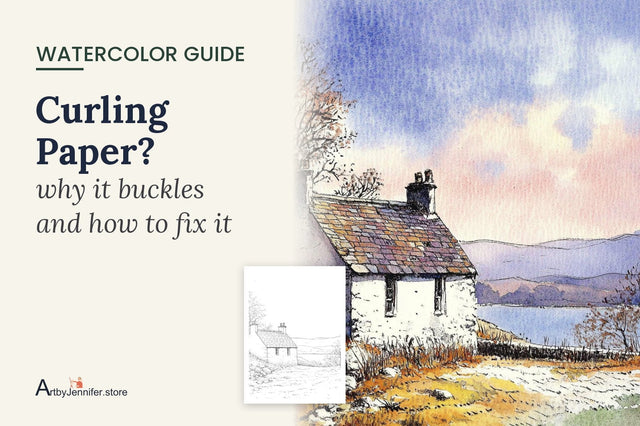
If a finished page still curls, lay it face down on a clean towel, cover it with a sheet of paper and stack a few heavy books on top overnight. It comes out flat and ready for a frame.
If your paper curls, buckles or pills more than this, Why Does Watercolor Paper Curl, Buckle or Pill? goes through each problem and how to fix it.
A paper test you can do today
If you have two or three kinds of paper at home, print the same page on each, then paint the same small area, a wall or a patch of sky, with the same mix. Lay a wash, let it dry, add a second layer and try lifting a little color with a damp brush.
Within half an hour you'll see which paper keeps washes smooth, which one ripples, and which one survives a second layer.
Paper problems and fixes
| What you see | Why it happens | What to try |
|---|---|---|
| Page buckles and paint pools | Paper too light, edges free | Switch to 140 lb / 300 gsm and tape all four edges |
| Washes dry streaky | Smooth paper, or too little water | Try cold press instead of hot press, and use a little more water |
| Surface turns fuzzy | Scrubbing or too many layers on cellulose | Stop scrubbing; keep to two or three layers |
| Printer jams | Sheet too thick or not trimmed exactly | Use the rear feed slot, trim sheets exactly, feed one at a time |
| Lines smudge when wet | Water-based ink not fully dry | Let ink dry overnight, or print with pigment-based or laser ink |
Frequently asked questions
What is the best paper for watercolor coloring pages?
For most people, 140 lb / 300 gsm cold press watercolor paper. It handles wet washes, prints in many home printers and keeps printed lines clean.
Can an inkjet printer print on watercolor paper?
Often, yes, if it has a rear or manual feed slot and accepts heavy paper. Trim the sheet to the exact size, feed it one at a time, and test that the ink doesn't run before you paint. If your printer can't take it, print at a copy shop or trace the page onto watercolor paper.
Can I use cardstock for watercolor?
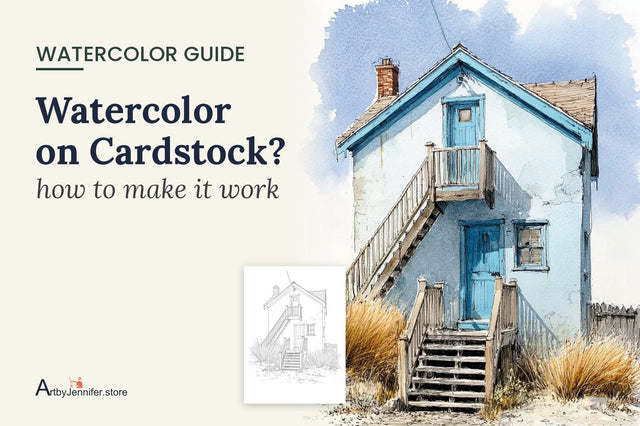
For light washes, yes. Cardstock isn't sized for water, so it buckles and absorbs paint unevenly under heavy washes. Use 110 lb or heavier and a little less water; Can You Watercolor on Cardstock? explains how. Mixed media paper is a better budget option.
Is cotton watercolor paper worth the money?
For practice, no. For a page you want to frame or give away, yes. Cotton paper blends more smoothly and survives lifting and layering much better.
Practice pages
The 84 Simple Houses set is ideal for testing papers, because every house has simple shapes and big, even walls where you can see exactly how a wash behaves. Each design comes painted, with a color guide and as clean line art, sized for US Letter and A4.
Once your paper is sorted, the next thing to get comfortable with is the brush: Watercolor Brush Control: Five Strokes Every Painter Needs.